









Administration
Introduction
In ShowVoc the administrator is the only user authorized to manage some "behind the scene" aspects of the platform. The administrator user can log in to the system through the Login button located in the upper right corner of the application. Once the administrator is logged in, a dropdown menu takes the place of the Login button. From this menu it is possible to access the administration dashboard or to log out.
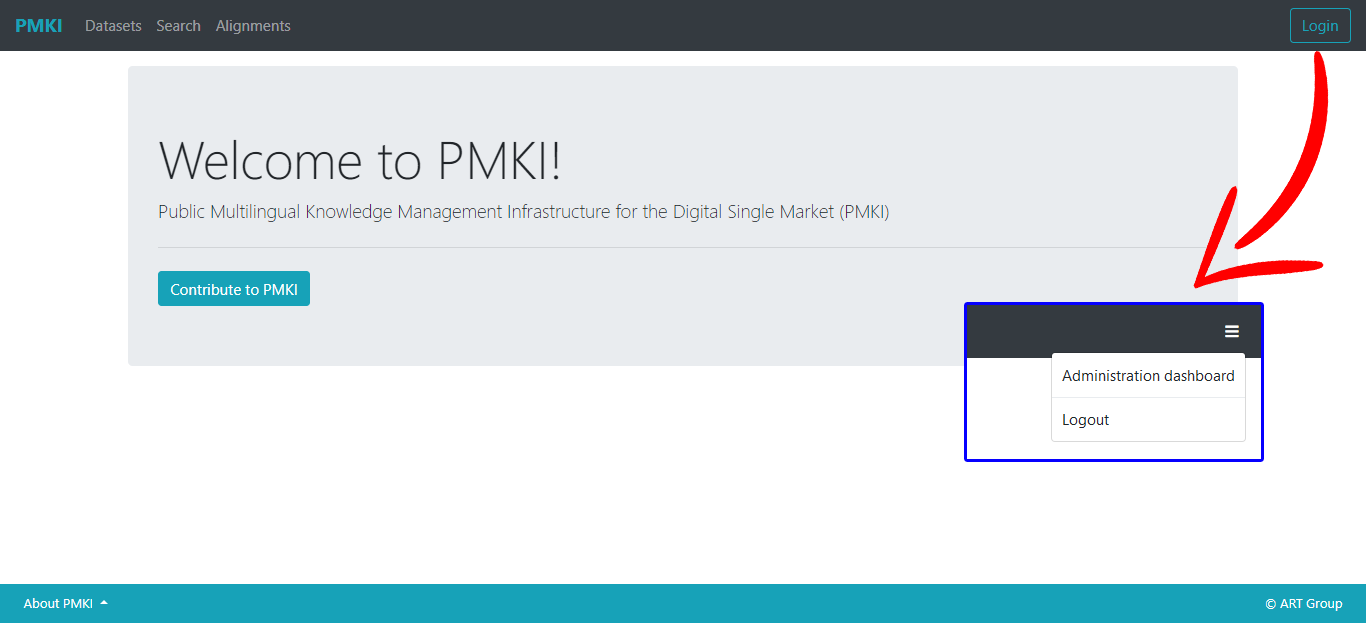
By clicking on the Administration dashboard item, the administrator lands directly on the Datasets manager dashboard. Dedicated documentation about this dashboard is available here.
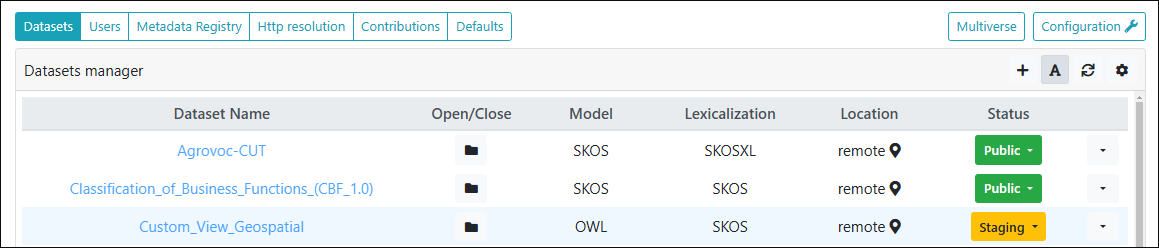
You can also use the buttons at the top to access panels for managing Users, Metadata Registry, HTTP resolution and Content Negotiation, Contributions requests, and other tasks. However, this page deals with system configuration. It is the same configuration panel that is prompted at the first access to ShowVoc.
System configuration
From the Configuration panel, it is possible to configure some core aspects of the system. These configurations are not mandatory, but they are needed in order to make the whole system work as expected.

The following configuration sections are available.
Email configuration
The ShowVoc e-mail service is used to send notifications to the contributors and to the administrator itself. Its configuration is particularly important. If it is not properly configured, the system will not be able to send email notifications to the contributors with the details required to complete the contribution.
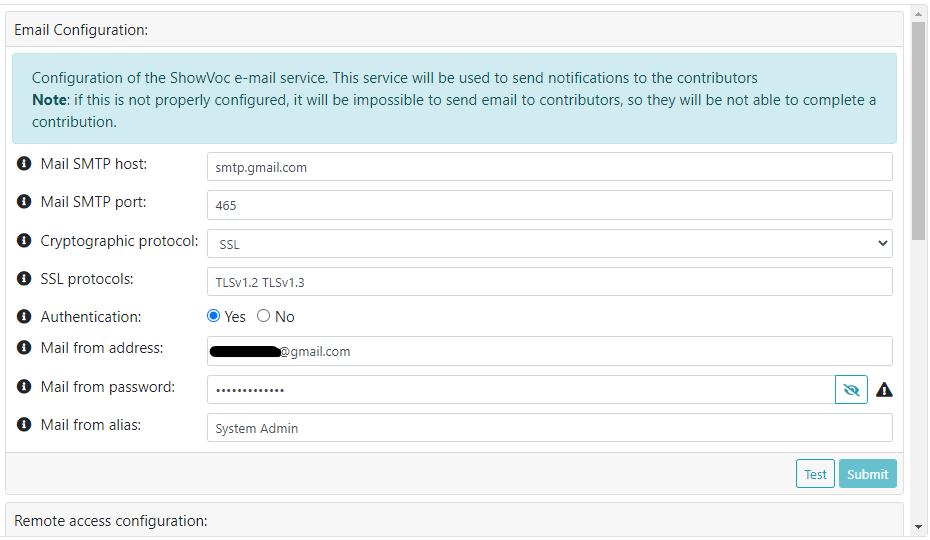
Properties:
- Mail SMTP host: the IP/URL of the SMTP mail server;
- Mail SMTP port: the port of the SMTP mail server;
- Cryptographic protocol: the cryptographic protocol used: could be SSL, TLS or None if not used;
- SSL protocols: specifies the SSL protocols that will be enabled for SSL connections (prompted only if SSL is chosen as Cryptographic protocol);
- Authentication: specifies if the authentication is required in the mail server;
- Mail from address: the email address used to send administration notifications;
- Mail from password: the password of the previous email address (required only if Authentication is Yes;
- Mail from alias: the alias name shown in the sent emails.
Remote access configuration
This panel is dedicated to configuring the remote triple store that hosts the datasets in ShowVoc (usually a GraphDB instance). If this is not configured correctly, ShowVoc will not be able to create remote datasets for hosting stable resources. It will only be possible to create local datasets.
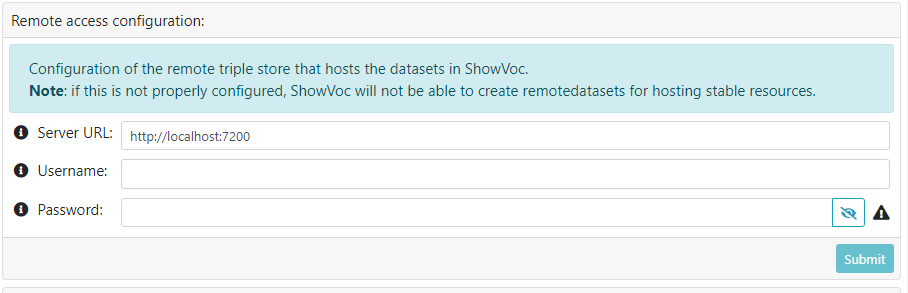
Properties:
- Server URL: URL/IP of the triple store;
- Username: Username for authentication (if any);
- Password: Password for authentication (if any).
VocBench configuration
VocBench configuration: Configuration of the VocBench/SemanticTurkey instance dedicated to the development of unstable resources. If this is not properly configured, ShowVoc will not be able to connect with VocBench, so it will be impossible to accept contributions for under-development resources.
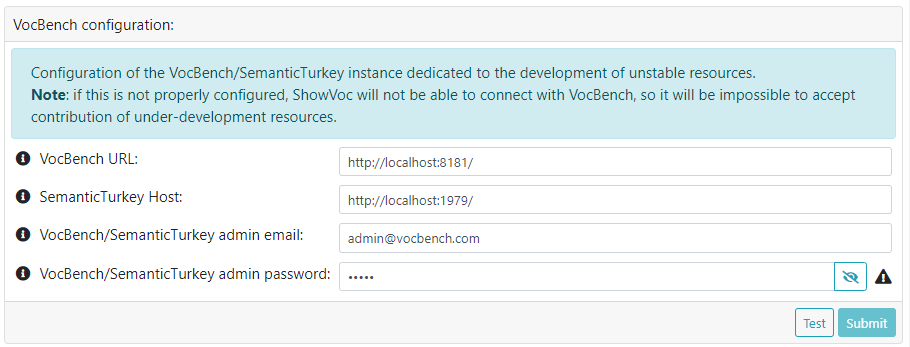
Properties:
- VocBench URL: URL of the VocBench instance accessible by the contributors for the editing of development resources. This URL will be sent to the contributor in the email notification about accepted contributions;
- SemanticTurkey Host: Complete URL (protocol+hostname+port) of the SemanticTurkey host;
- VocBench/SemanticTurkey admin email: email address of the administrator user in VocBench;
- VocBench/SemanticTurkey admin password: password of the administrator user in VocBench.
For the email and VocBench configurations it is available a Test button useful to check that the provided info are valid. In the first case a sample email is sent to an address provided by the user; in the second, a login request with the given credentials is performed to the given SemanticTurkey host.
Optional Features
Provides the possibility to enable some optional features. These are:
- Enable 'Contribute to ShowVoc: to enable the possibility to suggest new additions in ShowVoc.
- Enable Digital Objects Annotation: (default: disabled) to enable the showing, if present, of the various Digital Objects used to annotate resources and projects. It is possible, by clicking on the Import/Export buttons to import previously exported Annotations of Digital Objects (and how the import should be done, so if the old Annotations of Digital Objects will be deleted or not) or to export the current Annotations of Digital Objects. It is also possible to delete all the current saved Annotations of Digital Objects, clicking on the "Clear" button. The Key button is used to create an App Key, which will be used by the various widgets to create the Annotations of Digital Objects. To see how the Annotations of Digital Objects are shown in ShowVoc, please refer to the metadata page and to the dataview page.
-
Enable Datasets Catalogs: (default: disabled)
When enabled, the Dataset Catalogs page becomes accessible according to the user group selected in the dropdown menu.
Administrators can control visibility and access based on organizational policies.
The following access levels can be configured for this page:
- Any user – the page is accessible to all users, including anonymous visitors (Visitor User).
- Registered users – only authenticated users can access the page.
- Administrators – access is restricted to administrator accounts.
- SuperUsers – access is granted only to superusers and administrators.

Other Settings
There are five other settings in this section:
- External URL: The externally accessible base URL of the API. If the server is behind a proxy, provide the proxy's public URL.
- Preload profiler threshold: Tells the threshold file size (in bytes) admitted by the preload profiler during the project creation. If unspecified, or 0, the default size is 1048576 bytes (1 megabyte).
- Authentication mode: Specify the mode for authenticating to the platform. Detailed documentation is here.
- Allow anonymous access: Specifies whether anonymous (unauthenticated) users can access datasets for read-only actions.
- Enable experimental features: Check this option in order to enable experimental (very unstable) features.

Content customization
The Content Customization section, accessible from the Administration Dashboard, allows customization of various visual elements of the application, such as the navbar, footer, and home page, as well as the dynamic creation of additional pages.

Navbar customization
Different panels are dedicated to navbar customization: the Navbar Brand Content, Navbar Additional Content, and Navbar Custom Links panels.
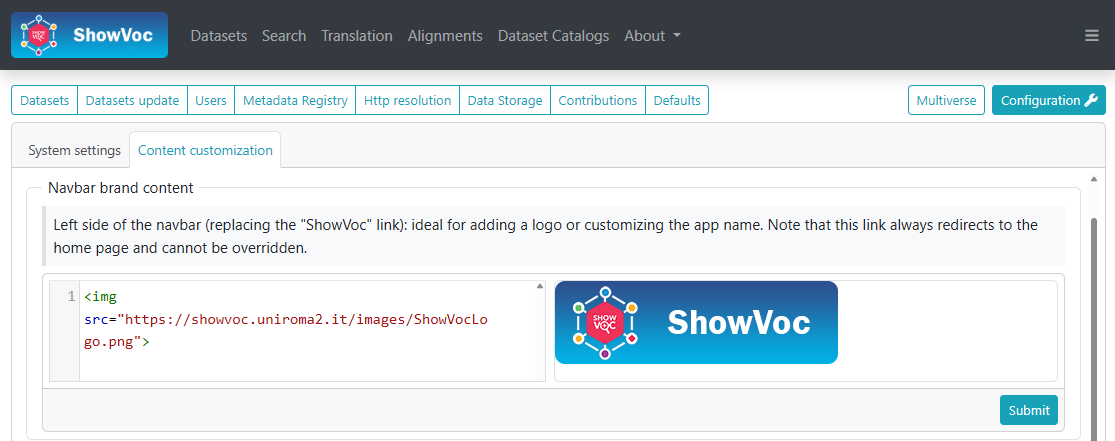
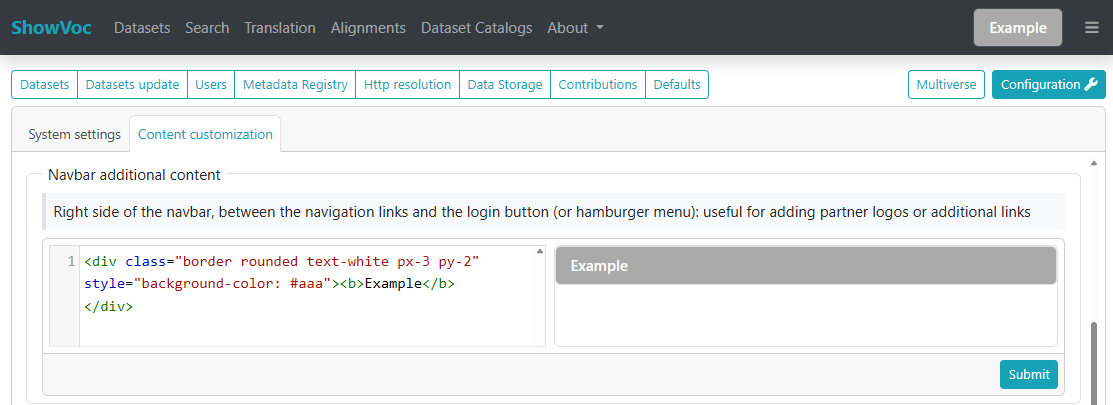
The first two panels allow customization of specific sections of the navbar by inserting custom HTML content.
- Navbar Brand Content: This panel manages the left side of the navbar, replacing the default "ShowVoc" link. Note: even if customized, this link always redirects to the home page and cannot be modified. It is intended for inserting a logo or customizing the application name.
- Navbar Additional Content: This panel manages the right side of the navbar, located between the navigation links and the login button (or hamburger menu). It can be used to display partner logos or additional navigation links.
Each panel consists of an HTML editor on the left side, used to define custom content; a preview area on the right side (initially empty), displaying the rendered result of the entered code; and a Submit button at the bottom, allowing the applied changes to be confirmed.
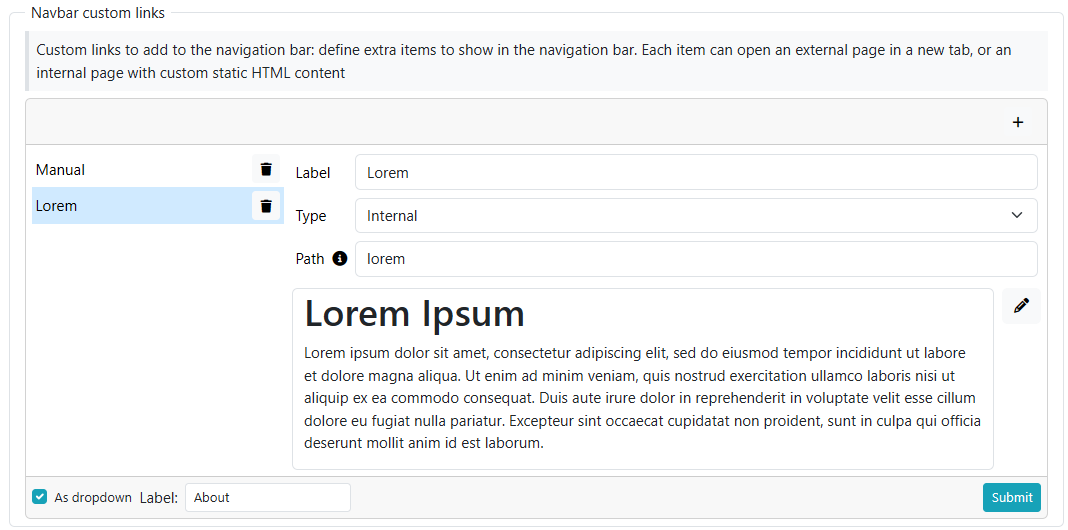
The Navbar Custom Links section allows the definition of additional items to be displayed in the navigation bar. Each custom item can either open an external page in a new browser tab or an internal page containing static HTML content.
The editor in this section is presented as a card layout. On the left side, a list of custom navigation items is displayed. When an item is selected, its details appear in the editor on the right side. New menu items can be added by clicking the + button located in the top-right corner of the card header.
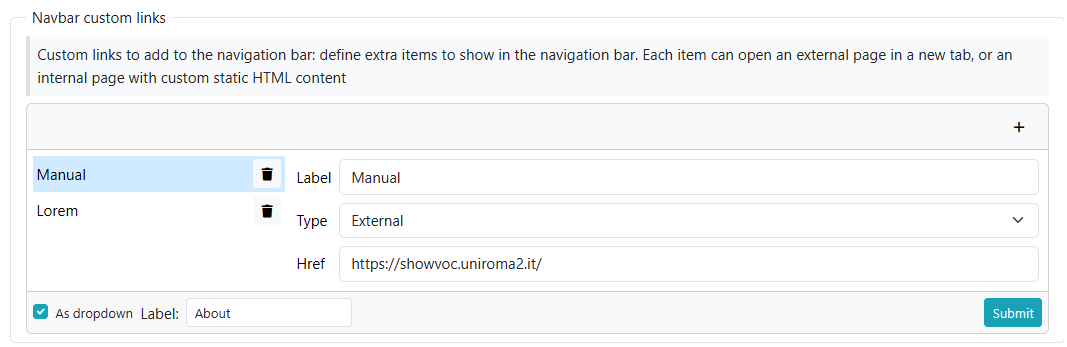
Each item can be configured with the following options:
- Label: the text displayed for the corresponding menu entry in the navigation bar.
- Type: defines the item behavior, which can be either external or internal.
An External item requires specifying an href value, representing the URL to open when the menu entry is clicked.
An Internal item requires specifying a path, which defines the URL path where the new page will be available. A tooltip clarifies that the path should be provided without a leading “/” or domain (e.g., path1). When this option is selected, a preview area appears, showing the custom HTML content that will be displayed on the internal page.
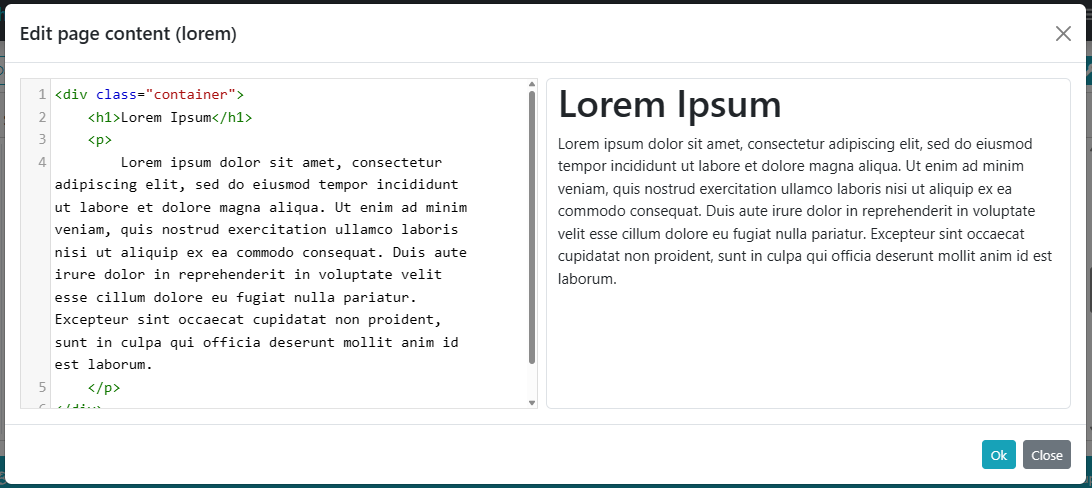
The internal page content can be edited by clicking the pencil icon located to the right of the preview. This opens a modal window with a two-column layout: the HTML editor on the left and the live preview on the right.
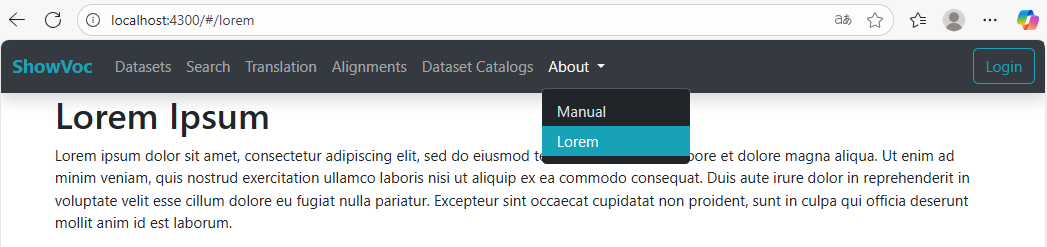
The footer of the card includes an As dropdown checkbox. When enabled, all defined menu entries are grouped under a single dropdown menu in the navbar, which can be assigned a label. On the right side of the footer, a Submit button is available to confirm and apply all changes.
Home customization
The Home Content panel allows customization of the main area of the home page, located just below the default "Welcome to ShowVoc" banner.
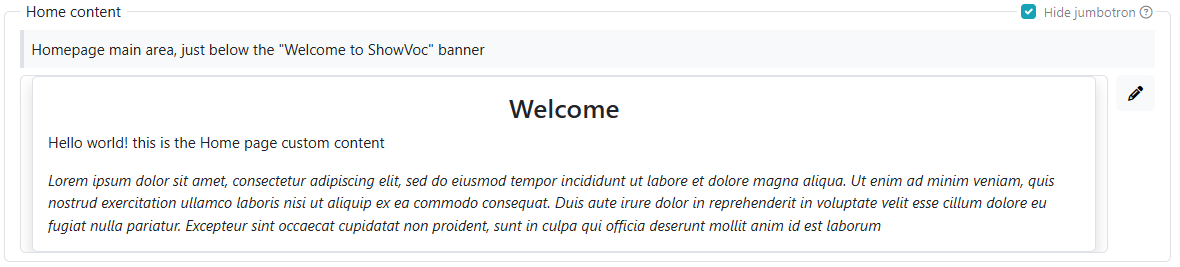
The panel displays a preview area showing the customized homepage content. To the right of the preview, a button is available to open the HTML editor in a dialog window, allowing modification of the displayed content.
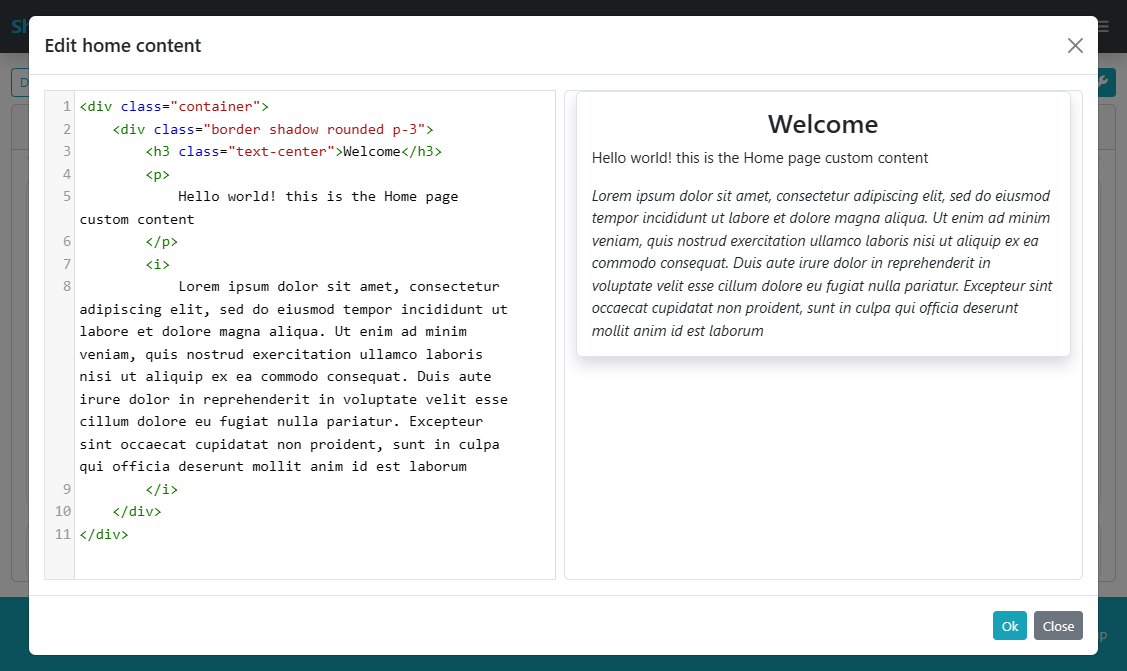
In the top-right corner of the panel, a Hide jumbotron checkbox is provided. When enabled, this option hides the default content normally shown in the ShowVoc home page.
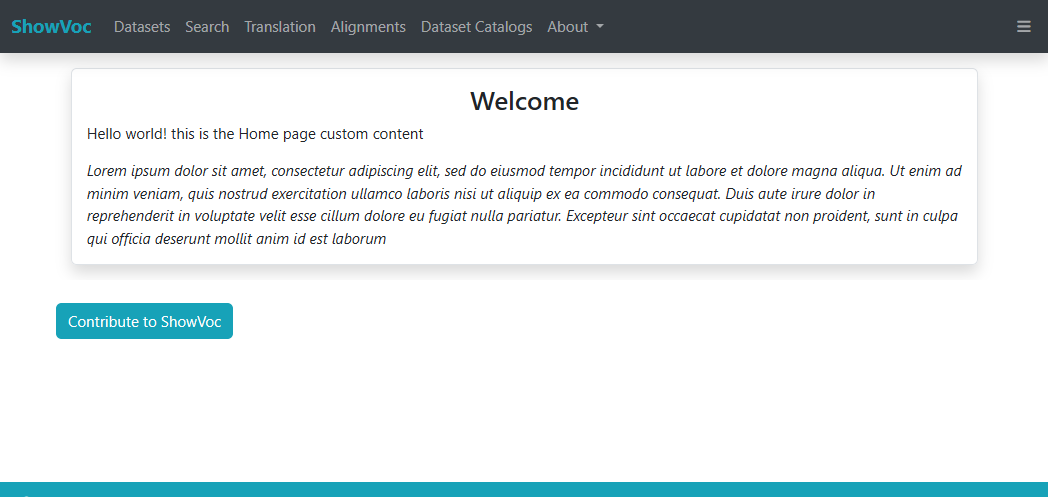
A further (limited) way to customize the home page is described here
Footer customization
Finally, the Footer Content panel allows customization of the central section of the application footer.
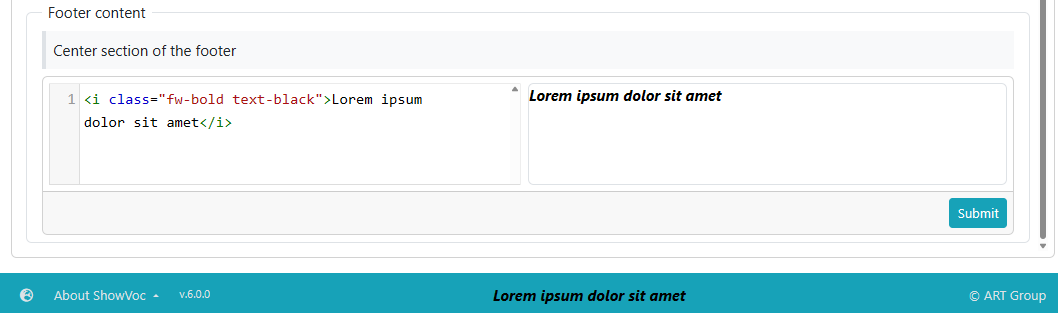
As with the other customization panels described above, the layout consists of an HTML editor on the left side, used to define the custom content, and a preview area on the right side, displaying the rendered result of the entered code.
At the bottom of the panel, a Submit button is available to confirm and apply the changes.
The Statistics widget
In both the home page and custom dynamic pages, it is possible to include a special element, the Statistics widget, which displays system-wide data statistics.
To insert this widget, the following selector must be added at the desired position within the HTML content:
<st-component data-type="stats"></st-component>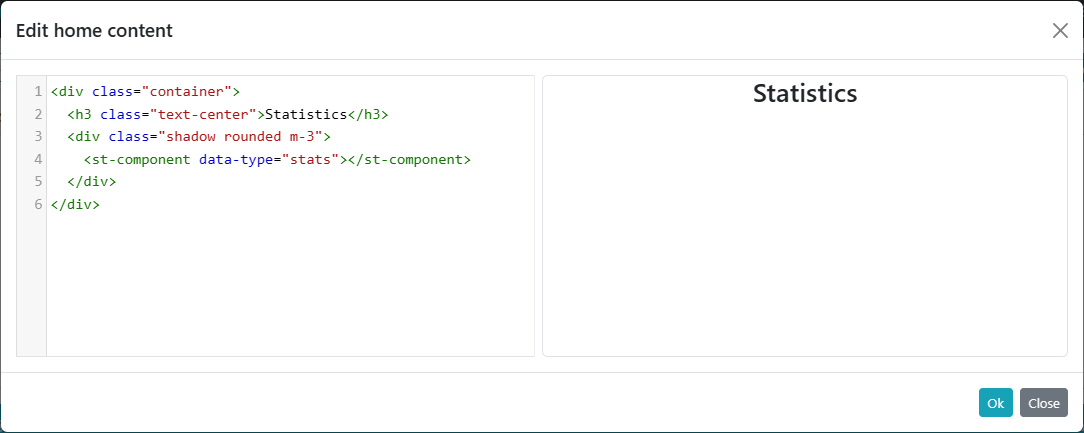
At runtime, this selector is replaced with the statistics widget, which reports various aggregated metrics, including:
- the number of available thesauri (SKOS datasets);
- the number of ontologies (OWL datasets);
- the total number of SKOS concepts, classes, and properties;
- the number of languages used for resource lexicalizations across the indexed datasets.
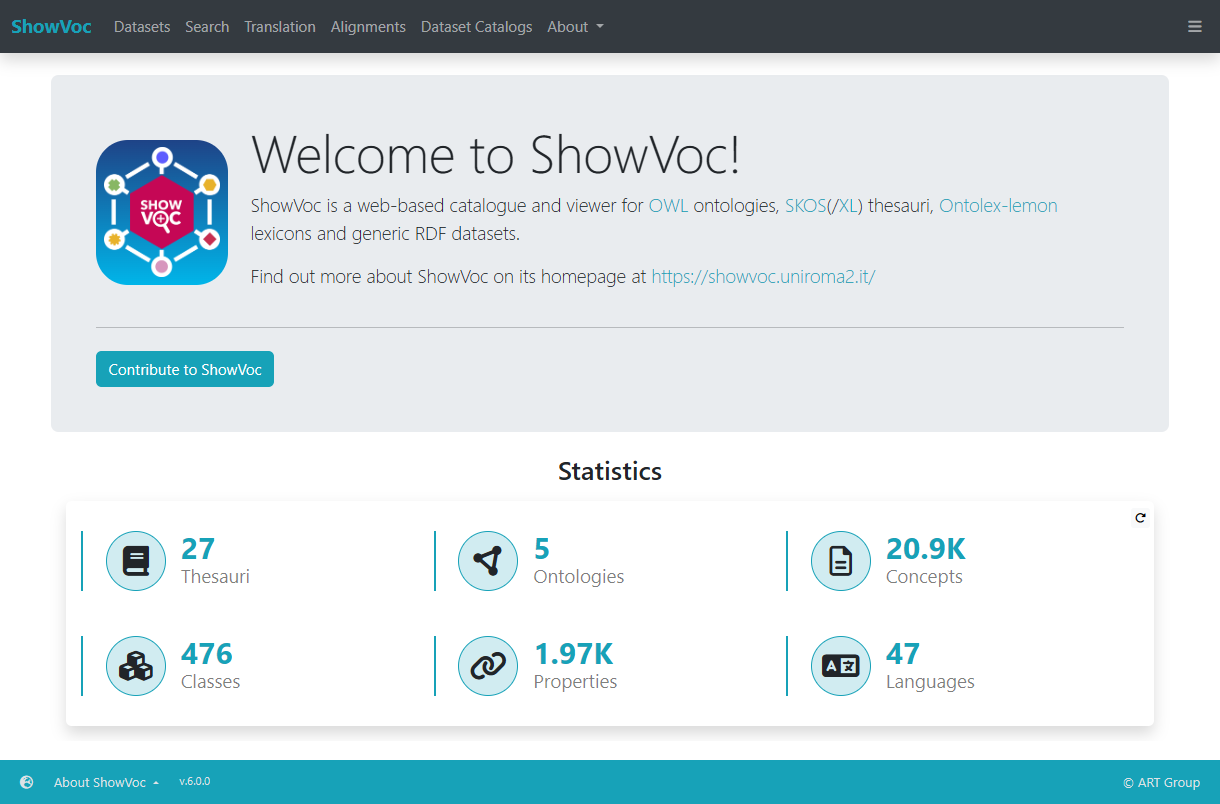
The displayed data are collected exclusively from indexed datasets. In the top-right corner of the widget, a refresh button, visible only to administrator users, allows recalculating the statistics. Since their computation may be resource-intensive, the results are cached after the first calculation and reused for subsequent views.
App Keys
The App Keys service in ShowVoc is used to allow a remote host (client) that does not have an associated user account to invoke specific ShowVoc services. This mechanism enables controlled, service-level access without requiring standard authentication.
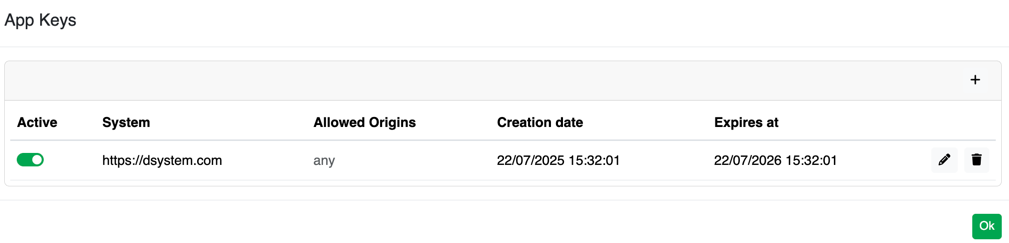
Currently, the only functionality that relies on App Keys is the Digital Object Annotation feature.
Administrators can create and manage App Keys from this section. When creating a new App Key, the following properties must be provided:
- System – the IRI of the external system that will invoke the service.
- Allowed Origins – the host (or list of hosts) from which the service calls will be accepted. Only requests coming from these origins will be authorized.
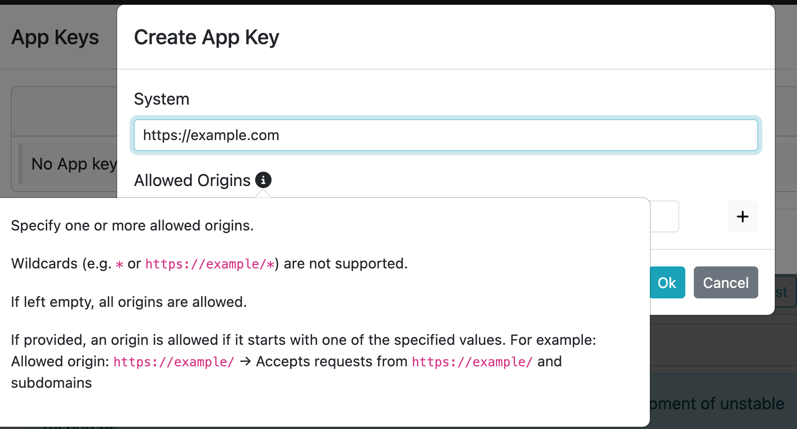
For security reasons, the App Key value is displayed by the system only once, immediately after creation. If the key is lost or not stored securely, it cannot be recovered and must be regenerated.
To invoke a ShowVoc service using an App Key, the client must include it in the HTTP request header:
X-API-Key: <APP_KEY_VALUE>
By default, each generated App Key is valid for 1 year starting from the creation date. Administrators may disable an existing key at any time, blocking further access without deleting it.
Once created, App Keys appear in the management table, where administrators can edit their properties or disable them according to system policies.